“The camera is an instrument that teaches people how to see without a camera.”
Dorothea Lange
A photographic approach to finding a visual language of your own.
Icons of the individual gaze
The history of photography is full of people who stood out not for technical mastery but for a way of seeing that belonged only to them. Their pictures were never merely documents — they were thought, emotion and attitude made visible.
Henri Cartier-Bresson, the master of the decisive moment, did not simply photograph what unfolded in front of him — he anticipated it. With a feeling for geometry, intuition and compassion, he caught fleeting scenes in their most meaningful second.
Diane Arbus turned her camera towards people at the margins of society — not as curiosities, but as equals. Her direct, uncompromising portraits questioned convention.
Saul Leiter transformed the everyday into painterly composition. Through reflections, panes of glass and fields of colour he let reality slide into abstraction, proving that there is often more truth in what is out of focus.
Sebastião Salgado documents global hardship and hope in epic black-and-white projects, and in doing so conveys a deeply humanist view of the world. His eye recognises suffering and dignity with equal clarity.
These photographers did more than make pictures. They showed — through a point of view that was entirely their own. That is the heart of seeing differently.
The philosophy of seeing
Seeing differently begins with a simple realisation: the world looks different to everyone.
Our background, our culture, our emotions and memories all shape the way we look. Photography is therefore not only a technical act but a translation of an inner gaze into an outer image.
To see differently is to notice what others overlook. The British art critic John Berger put it precisely: we only see what we look at, and looking is an act of choice.
Your photographic vision is a filter. What genuinely interests you? What moves you? Where does your curiosity go? That is where your seeing begins.
Eight ways to sharpen your eye
- Slow down. The obvious is rarely the most interesting. Walk more slowly. Look for longer. Wait. Many good pictures appear after the moment you were ready to move on.
- Ask questions before you photograph. What is the story here? What is the mood? What is missing from the frame? Photographing is not about giving answers — it is about asking visual questions.
- Study rather than imitate. Look at the work of others, not to copy it but to understand it. What is it in their visual language that touches you? Then pick up the camera and go your own way.
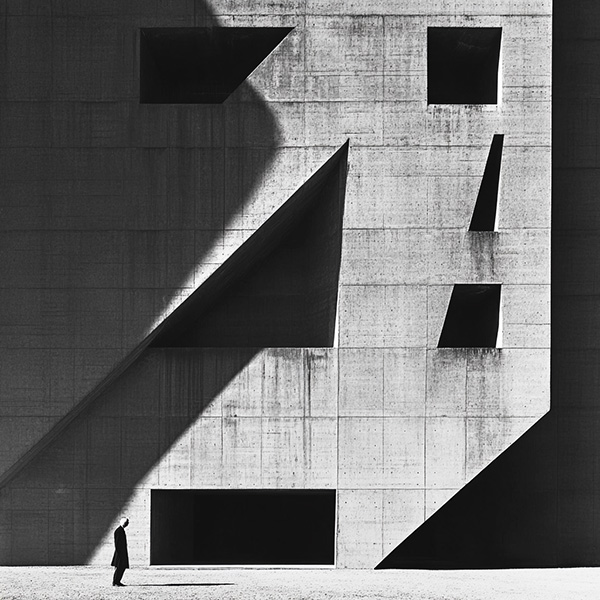
- Work with constraints. Limit yourself: one lens, one place, one colour, one feeling. Constraints sharpen the eye. They shift attention from the what to the how.
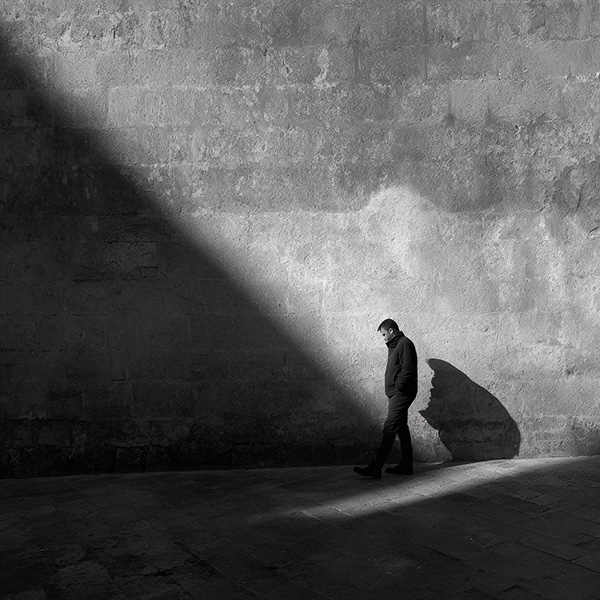
- Look beyond the subject. Backgrounds tell stories. Light shapes mood. Shadows whisper. Reflections deceive. The surroundings are often as significant as the subject itself.
- Let go of perfection. Technical perfection rarely produces emotional depth. Blur, grain, a tilted frame — if they serve the statement, they are worth keeping.
- Keep a visual diary. Photograph daily, not for the masterpiece but for the seeing. Phone or camera, it makes no difference: the eye is a muscle and it needs training.
- Return to the same places. Go back. Seeing again is one of the keys to seeing differently — in another light, in another mood, with another set of experiences.
Seeing differently while travelling
Anyone who travels with a camera carries more than equipment; they carry a way of looking. The temptation to collect the familiar postcard view is strong, and that is exactly where the danger lies.
Instead: stay curious. Linger. Pay attention to gestures, signs and structures. Think in fragments and emotions rather than grand landscapes. Ask yourself how a place feels — and how you might show that in a picture.
An experienced photographer once told me: don’t photograph how it looks, photograph how it feels. That is the whole difference.
Closing thoughts
Photography is not a mirror of the world but an expression of your perspective. Seeing differently means avoiding clichés, questioning the obvious, and giving yourself to details, moods and the spaces in between.
You do not need exotic places. You need attention. Honesty. And the confidence that your point of view — however quiet or unusual it may be — has a validity of its own.
In the end, the strongest pictures are not the ones with the most spectacular backdrop. They are the ones in which you can recognise the soul of the photographer who made them.
Further reading: in my series on minimalist landscapes I show how “less” can become the key to seeing more intensely.