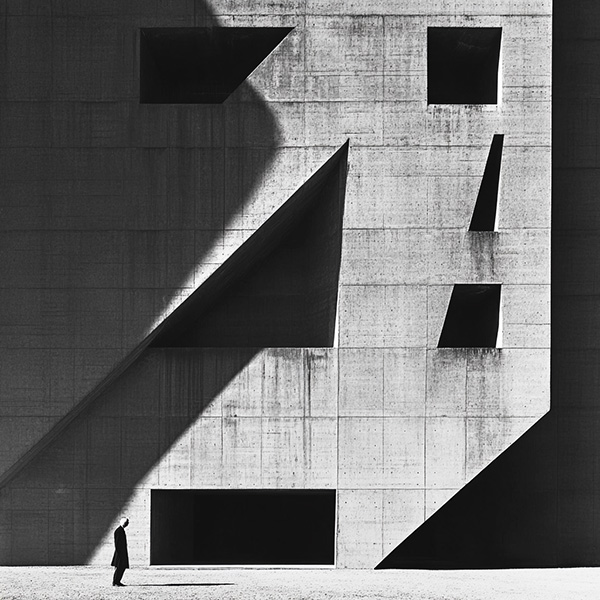
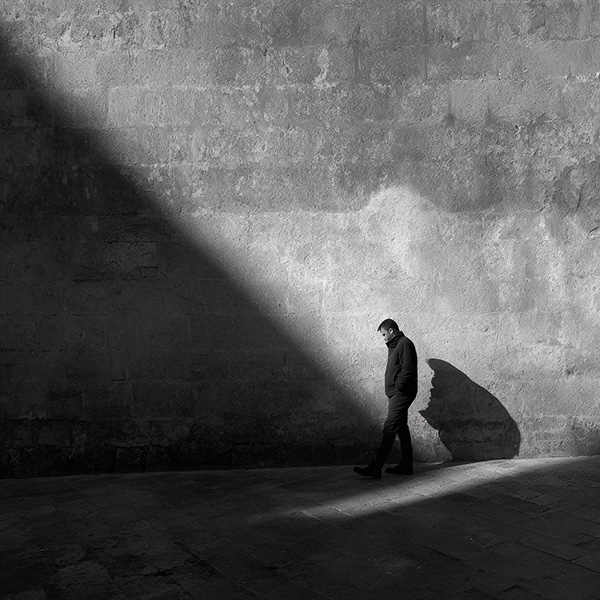
For more than twenty years I have walked through cities with a camera over my shoulder — not for the skyline, but for the quiet gestures that play out down at ground level, where human lives meet without a script. Street photography is, for me, less a genre than a school of attention. It is about being radically present in a world that is forever passing us by.
The art of noticing
Street photography is often misunderstood as a search for the spectacular or the eccentric. That is not what it is about. It is about observing — about genuinely perceiving what most people overlook. A man in the rain, a woman shielding herself from the wind, a fleeting glance between strangers. Those brief moments are the raw material. But the real craft lies in catching them with clarity, with respect, and with an intuitive feel for visual composition.
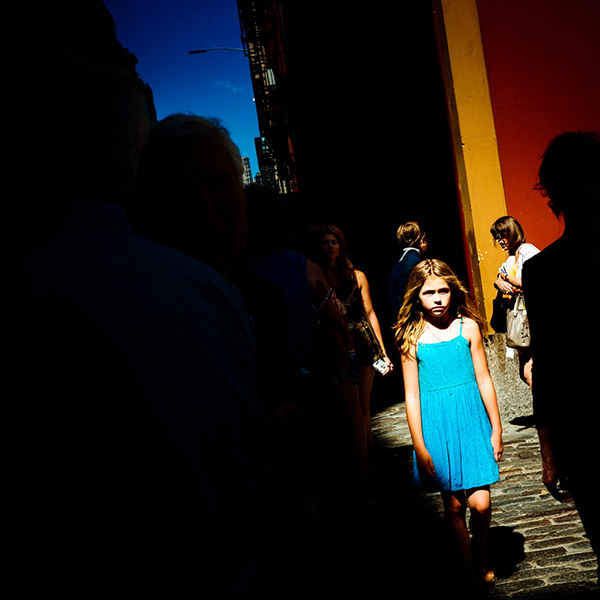
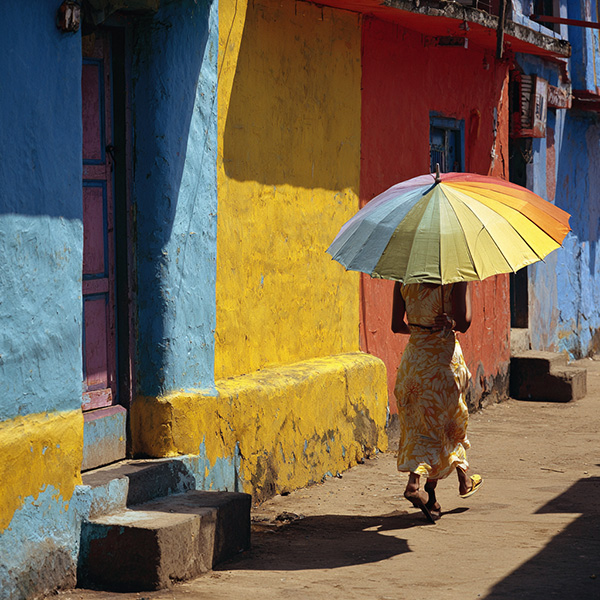
I am often asked: “What are you looking for?” The honest answer is: nothing — and everything. The beauty of this practice is that you have to work without a fixed idea. When I am out on the street, I let go of expectation. I pay attention to the light — how it grazes a wall or falls between buildings. I see shapes and movement, reflections in shop windows, patterns in the way people walk, repetitions of colour in clothing, signs, shadows. The street offers an endless supply of compositions. It is a kind of visual jazz: improvisation with structure.
The myth of the unposed
There is also the myth that street photography must be entirely unposed, that any interaction with the subject destroys the purity of the moment. I do not quite agree. Sometimes a direct look into the camera can be more powerful than anonymity. What matters is not whether the moment was staged or spontaneous, but whether it feels true. What matters is whether the photograph holds on to the energy of the original moment — the tension, the humour, the melancholy.
A great deal of my work comes out of waiting. I return again and again to the same street corner, the same shop window, the same underground entrance. I learn their rhythms, their moods. I do not go out “to take photographs”. I go out to see. And when the right moment arrives — gesture, light, surroundings — it is as though an inner bell rings. You feel it before you have even raised the camera. It is instinctive, physical.
Suggestion, not explanation
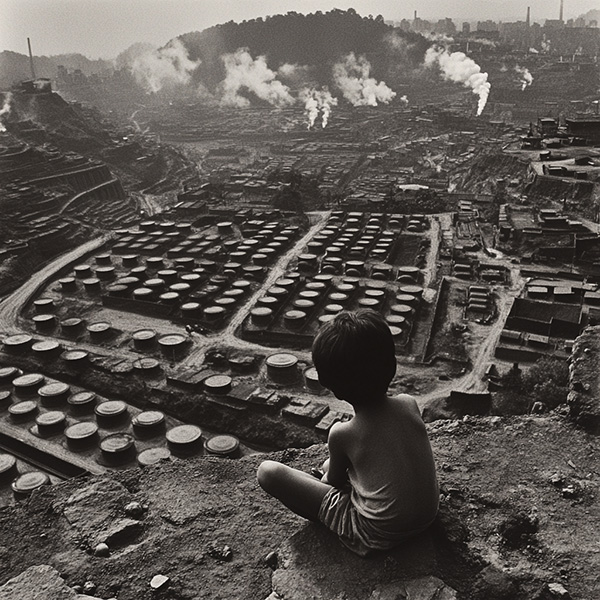
At its best, street photography is free of brief and free of intention. Unlike documentary photography, which often wants to explain, street photography wants to suggest. It leaves room for the viewer. The meaning is not fixed; it comes into being somewhere between the picture and the imagination. One photograph may tell a story. Another only summons a feeling. Both are legitimate.
I have found that the real significance of my work often only becomes visible in hindsight. You photograph for years on instinct — and only later, going back through the pictures, do you recognise the patterns: solitude in the crowd, the repetition of routines, the architecture of waiting. These themes work unconsciously. You do not look for them; they find you. And at some point you understand what you were actually looking for all along.
Beyond the street
In recent years I have come to believe that street photography is not even confined to the street. Airports, lifts, back courtyards, office buildings — anywhere unstaged human life takes place, there are discoveries to be made. What matters is not the location but the disposition. A street photographer sees with a democratic eye: nothing is too ordinary to deserve attention.
In this practice the camera is not an instrument of power but a tuning fork. It helps us find resonance in the chaos. That is why I keep returning to it — not only to document the world, but to stay connected to it. To remind myself, over and over, that life is happening right now, and that even the most ordinary moment contains beauty, absurdity, mystery.
And perhaps that is exactly what makes street photography so timeless. It demands no performance from the world. It asks only that we look — closely, curiously and without judgement. In an age full of distraction, that alone is a radical act.