Your first 10,000 photographs are your worst.
Henri Cartier-Bresson
Every photographer is told, sooner or later, to find their style. It is one of those instructions that sounds like guidance and functions like a locked door. Find it where? Style is not an object lying in a drawer, waiting to be recognised. It behaves more like handwriting: something you cannot produce on demand, and cannot avoid producing once you have written enough.
Why “find your style” is poor advice
The phrase treats style as a decision — a look you select and then apply, much as you would choose a preset. Photographers who take it literally tend to end up with a costume rather than a voice: heavy grain because grain reads as serious, crushed blacks because contrast reads as bold, a colour grade borrowed wholesale from someone whose work they admire. The result is recognisable. It is not theirs.
The deeper problem is that the instruction inverts cause and effect. Nobody settled on a style and then made the pictures. The pictures came first, over years, and the style is what an observer noticed afterwards. Asking a beginner to start at the end is asking them to skip the part where the work happens.
Style is a residue
A more useful model: style is whatever is left over after you subtract everything you copied.
You begin by borrowing, as everyone does. Framing from one photographer, a way of handling light from another, a subject from a third. Most of it does not survive contact with your own practice. Some of it does — not because it is better, but because it happens to fit something that was already there: a tolerance for empty space, an impatience with faces, an attraction to the moment just before or just after the obvious one. That surviving remainder is your style. You did not choose it. You found out which borrowings you were unable to put down.
This is why style resists being rushed. Subtraction needs volume to work on. You cannot learn what stays until a great deal has passed through.
Imitation, done honestly
Imitation has a worse reputation than it deserves. Copied and passed off as your own, it is theft. Done openly, as a study, it is the sharpest diagnostic tool available — because the moment you try to reproduce another photographer’s way of seeing, you discover exactly where your own refuses to follow.
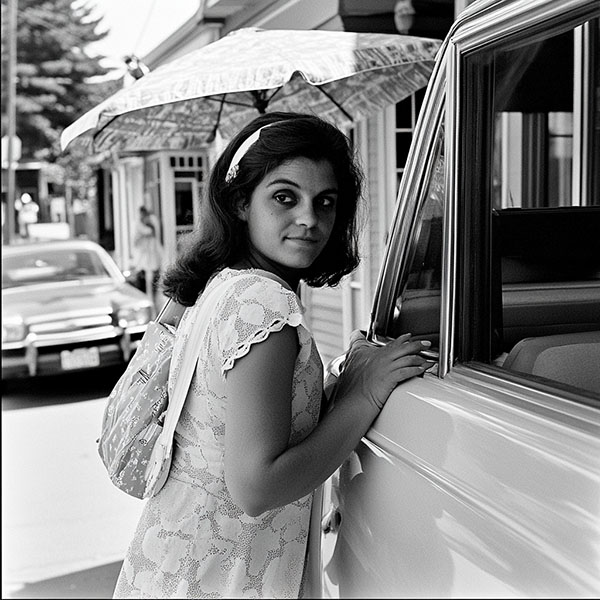
The two frames here are exercises of that kind. The first is a study after Vivian Maier: available light, no arrangement, the subject half-turned and looking straight back at the lens. The second reaches for Helmut Newton — deliberate, theatrical, aware of the camera and unbothered by it.
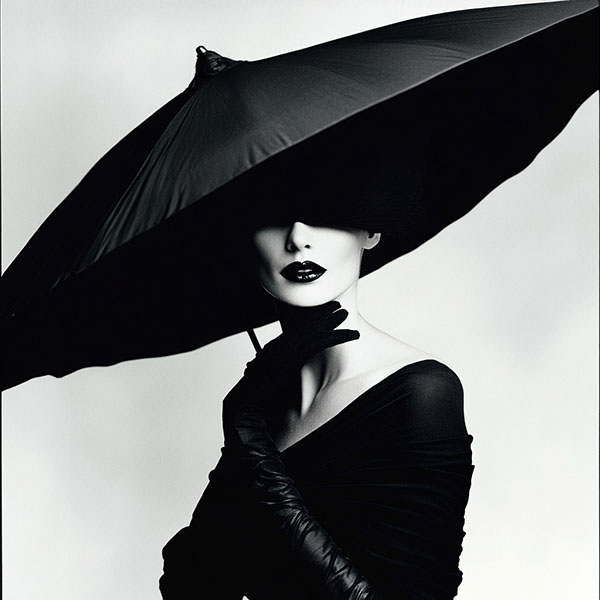
Neither is a convincing imitation, and that is the useful part. In the Maier study I kept tidying the frame; in the Newton study I kept softening the pose. Those corrections were not decisions. They were reflexes, and reflexes are the raw material of style. The resistance is the information.
Six constraints that build a style faster than any preset
- One lens for a year. A fixed focal length stops being a limitation after a few months and starts being a way of seeing. You begin composing before you raise the camera.
- One subject, repeatedly. The tenth photograph of the same façade is where invention starts, because every easy version is already used up.
- A fixed edit. Decide your black point, your contrast curve and your colour handling once, then leave them alone for fifty images. Consistency exposes what the pictures actually have in common.
- Print in small batches. On paper, at a fixed size, weak frames stop hiding behind a bright screen. Nothing teaches faster.
- Sequence rather than collect. Lay twelve images down and force them into an order. The ones that will not sit anywhere are usually the ones you made for someone else’s approval.
- Keep the rejects. Look at a year of them at once. The repeated mistakes are more revealing than the successes — they are the shape of your instinct, seen from behind.
How you know it is working
Style rarely announces itself. The usual first sign is a small irritation: you notice that you keep making the same picture and you cannot stop. The second sign comes from other people, who recognise a frame as yours before they have seen your name on it. The third, and the most reliable, is that decisions get quicker — not because you have rules, but because a growing number of options no longer feel like options at all.
If none of that has happened yet, the answer is almost never a new camera or a new preset. It is more frames, more subtraction, and more patience with the part of the process that looks like repetition and is actually refinement.
Closing thoughts
Style is not a look, and it is not a brand. It is the accumulated evidence of what you cannot help noticing. Chasing it directly tends to produce imitation; working steadily at something you find genuinely interesting tends to produce it as a side effect. The useful question is not “what is my style?” but “what do I keep going back to, and why has nothing talked me out of it?”
Further reading: Learning to See Differently looks at the habits behind a visual language, and The Art of Fine-Art Portraiture takes the same questions into portrait work.